As part of my continuing effort to self host all my own work I present the talk I gave at linux.conf.au in Christchurch in 2019. It was my first time either attending or presenting and I was stoked to get a standing ovation.
Edited Transcript.
I am a pagan Theologian, who is of course the exact person you want speaking at Linux conf, and I’m a virtual world developer. For my PhD I studied religion in virtual worlds to try to answer the question, if you do a ritual in a virtual world is it a real ritual? Of course this led me down some very very deep ontological rabbit holes. “Why is this an important question?” I hear you ask. I’m fairly sure that one or two of you will be gamers. When one is a gamer one is often asked, “why do you spend so much time gaming? Why don’t you get out and do something in the real world? That’s not real”. In sociology there’s a theorem called Thomas’s theorem, coined by Mr and Mrs Thomas, which says, if men define situations as real, they are real in their consequences. Basically that means if you think it’s real it’s real to you. People have been killed over gaming, people have neglected their children until they die because of gaming, and people have neglected themselves until they die because they would rather be gaming. This seems pretty real to me. This is my thesis, Virtually Real: being in cyberspace, which you can download from here1.
While people ask if gaming is real they don’t often inquire about the ontological status of programming. Obviously code is real because we pay people money to do it. It must be real, our society runs on it. It’s not like people are programming for fun or anything. That statement tells us a lot about our society’s relationship to work, fun and money, all of which are problematic. Coding is real because it’s real in its consequences. People get killed by code all the time. Any day now Hal will be refusing to open the pod bay door.
Humans need Gods. Every single human society that we know of has had gods and there is a really good reason for that. Gods give us things to look up to, they are things we can aspire to. They keep us heading in the right direction, the direction of right, and serve as an Exemplar. I know right now that a lot of you are thinking about your own experiences with religion and the dismal performance of many allegedly religious people that we are seeing in our society today. And you are right to deride the hypocrisy of those people who set themselves up as moral exemplars and yet betray the very principles they seek to promote. I was raised a Catholic. Catholicism is the proprietary version of religion. One guy owns it. You can’t access the source directly, you have to go through an intermediary, and if you contravene the terms and conditions they will rain fire down on you, literally. Now I’m a Pagan which is open source religion. There are a million different distros, you can access the source directly, you can repackage other people’s distros, you can incorporate source information from other distros, and make your own one. It is antithetical to the concept of intellectual property. No one owns it and anyone can modify it.

In my thesis I focused on ancient Egyptian religion and I’d like to introduce you to a key goddess from that culture. Her name is Ma’at. Ma’at is the goddess of truth and justice and order. She represents both the moral ideal and the code of conduct one should follow to attain the ideal. She represents the moral principles every Egyptian citizen was expected to follow throughout their daily lives. They were expected to act with honor and truth in all matters that involve the family, the community, the nation, the environment, and the gods. The entire focus of ancient Egyptian religion was the preservation of Ma’at. If you didn’t uphold Ma’at the serpent Apep would come along and it’s all downhill from there. This is a really important message. Ancient Egyptian Society was one of the most stable, most successful, most long lasting cultures that we know of.
If you want ethical things to be paramount you have to put ethical things in a paramount position.
It’s not okay to say, “oh we’ll deal with ethical implications later”. Not happening. Why is all this stuff going down in our society? The West used to be one united thing called Christendom, where everybody shared the same moral code. Everybody knew what was expected from everybody else. But that’s all dying. We are in an axial age between the fall of Christendom and the rise of whatever moral framework is going to come next. But we don’t know what that is, so consequently we’re living in a kind of confused moral vacuum where the limits of right and wrong are quite frankly described only by profit.
The defining belief systems of our age are scientism and capitalism. “But science isn’t a belief system”, I hear you say, “science is empirical”. To you I say, science is a belief system founded on the idea that the scientific method is the only way to attain knowledge. It is inherently quantitative, unlike humans. Science however is not the problem, scientism is the problem. Scientism is the belief that science is the one true way. Most scientists are not scientismists. Scientists recognize the limitations of science, most of them, but scientismists don’t understand science, they believe in science. The problem with this is that science is a monognosticism, which means it believes there’s only one way to attain knowledge. Another problem with science is that it can’t be applied to everything. Science can tell you how to do things, but not if you should do them. These two things are the cause of much cognitive dissonance among the overly rational. These people are often attracted to software development.
From Protestantism capitalism has taken the work ethic, but it has stripped away the moral aspects. As you can see from this graph capitalism and the industrial revolution has made our lives materially heaps better, loads better. But we aren’t happy.

Meanwhile many wealthy countries are also suffering from growing rates of chronic diseases like obesity and diabetes along with mental health problems; stress, anxiety, depression. All exacerbated by an intense work culture, along with the use of the very devices that have helped generate unprecedented profits for technology companies. Despite a twenty fold increase in material wealth over the past three centuries people are not twenty times happier. In fact we are struggling to get by.
It’s almost as if capitalism is a really bad idea.
Here’s a quote from the renowned philosopher Angel the vampire. “Are we doing it because it is right, or because it is cost effective?”
Since its inception software development has been all about what can be done and what can’t be done. But it wasn’t about morality. It was about practicalities. What will compile, what won’t. What will work, what won’t. In the 1990s, which was a heady time, a time when the internet was all about freedom, John Perry Barlow published The Declaration of the independence of Cyberspace, in which he declaimed,
“Governments of the industrial world, you weary giants of flesh and steel, I come from cyberspace. The new home of mind. On behalf of the future I ask you to leave us alone. You are not welcome among us. You have no sovereignty where we gather.”2
It was all very stirring. I wanted to believe it. We all wanted to believe it. And at that time it was kind of possible to believe such statements, if you were really naive and had never studied history. As early as 1999 Lawrence Lessig, a professor of law at Harvard, was bursting the bubble. In his Code and Other Laws of Cyberspace he argues that while cyberspace could be a place of freedom, it could just as well be a place of exquisitely excessive control. Barlow claimed, “you have no moral right to rule us, nor do you possess any methods of enforcement we have true reason to fear”3. He was wrong about this. Julian Assange is a classic case of how he was wrong about that. I think he’s really fearing methods of enforcement at the moment. Barlow said, “You do not know our culture, our ethics, or the unwritten codes that already provide our society more order than could be obtained by any of your impositions”4, but he didn’t explain the basis of his code of ethics or morality. He was also wrong about this because he said “our culture”. His we is a singular we. He presumes one culture in cyberspace, and there’s not just one culture in cyberspace. There’s a million different ones. And finally he said, “We are creating a world where anyone may express his or her beliefs, no matter how singular, without fear of being coerced into silence or conformity”5. He was, sadly, right about this. Toxic discourse now fills all our feeds.
Cyberspace was open, but open is not enough. Things can be open and still be bad. Open doesn’t necessitate ethical use. If you decide to take an otherwise free and open source license and add a clause to it that says you cannot use this software to torture kittens, then it is no longer free and open source because it restricts certain uses.
I’ve been an editor of Wikipedia for 13 years. I’ve been a big supporter of the Wikipedia project but Wikipedia, despite being one of the most open projects that there is, everything is open on Wikipedia, however Wikipedia has been captured by radical pseudoskeptics. A pseudoskeptic is someone who pretends to be a skeptic but actually is not a skeptic. They’re just about information control. There’s a huge push on Wikipedia to portray alternative medicine, among other things, as pseudo science and GMOs as above reproach. If you want a really good example go look at the acupuncture article, which has been a flame war for the last four or five years. This is pure hypocrisy because these people are literally arguing that an expert on any topic they decide is pseudoscience cannot be cited on Wikipedia. Doesn’t matter if they’re published in a peer reviewed journal or academic press or anything. It has been decided that certain topics are pseudoscience and therefore you cannot cite those topics. Guerrilla Skeptics is a website where skeptics organize off Wikipedia in order to edit articles. This is totally and completely against Wikipedia’s rules but Wikipedia has done nothing about it. Eleven thousand people signed a petition to Jimmy Wales to say please do something about this problem and he came back with, “You guys are all lunatic charlatans and we’re doing nothing about this”.
Some of you may have heard of Rupert Sheldrake who is a fabulously famous biologist and author of more than 85 scientific papers and eight books. He was among the top 100 Global thought leaders for 2013 and on Research Gate his score of 33.5 puts him among the top 7.5% of researchers. But on Wikipedia his work is classified as pseudoscience and can’t be cited. Here’s an interesting thing, if the people on Wikipedia see this talk that I’m giving now they will be using it to try to get me banned. I am serious. They will really be doing that, that’s how far they are taking it. Open is not enough. Your project can be as open as anything and it can be hijacked by a group with an ideological agenda. You’ve got to move along to a more ethical framework.
What is ethics? What is morality? in 1967 Arthur C. Clark said, “As our own species is in the process of proving, one cannot have superior science and inferior morals. The combination is unstable and self destroying.”6 He is proving to be more and more prescient every day.
Ethics is the use of one’s rational faculties to examine moral questions and morality is to distinguish between what is right and proper and what is not.
Rationality is overrated. Rationality is easy. If one follows a set of steps, if the steps have consistency and if they’re followed correctly, it’s easy to determine if a thing passes a rational test. If all cats are black and a given animal is black it could be a cat. If the animal is pink and I say it is a cat then that fails a rational test. But there are some questions that you cannot use rationality to judge i.e. should I love my cat? Programming deals with rational and irrational but it can’t say anything about arational. Coding is all about the mind. There’s absolute truth and absolute falsehood, and it’s really easy to get caught up in that and think about what you’re doing and good ways to do things and not whether you should do them.
John Michael Greer, who some of you may know from such exciting series as Retrotopia and After Oil has a really good blog post about this on his site7. There are two classes of problems, convergent and divergent. Convergent problems have a single right answer. Divergent problems don’t have a single right answer. Divergent problems are problems of value while convergent problems are problems of facts. A convergent problem asks, what is the world? The divergent problem asks, what should I do about the world? For that latter question there’s no one answer that applies to everyone. It’s become popular in recent years for rationalists to insist that convergent problems are the only ones that matter. This is nonsense. What you should do for a living is a divergent question. The answer differs from one person to another. But how you answer that question has a far greater impact on your chances for a happy and productive life than any merely convergent question.

Now we’re going to examine some ethical issues. Everybody loves kittens! Is it okay to poke a kitten with a needle? When we’re talking about ethics there’s a couple of things that we usually mention and one is consent and the other is harm. I’m hoping we all will kind of agree that no it’s not okay to poke a kitten with a needle because a the kitten can’t consent and because the kitten is being harmed. Plus it’s mean. How can you do such a thing to a cute wee kitten?
What if I give you pizza if you poke kittens? No? What if you have a spouse and six starving children who really need that pizza to live? Then is it okay to poke the kitten with a needle to get the pizza to feed your six starving children and your spouse? I say no, because the kitten is still being harmed and the kitten still can’t consent, and it’s still mean. But then you might ask, is the kitten more important than your spouse and six starving children. Probably you’re going to say no, but does that make it right?
What if it’s an ugly kitten? Is it okay to pork an ugly kitten? No. The kitten is still being harmed and the kitten still can’t consent. Is it okay to poke an evil kitten? No. The kitten is still being harmed and the kitten can’t consent. Is it okay to poke a dead kitten with needles? The kitten is not being harmed and no consent can be obtained because is dead, but it’s creepy. Rationality can’t tell you anything about creepy. Would you tell your mum happily that you poke dead kittens with needles to get pizza? I’m guessing not. It’s not enough to do no harm. You have to provide a benefit. You have to be proud of what you do. What if nobody knows that you’re poking a kitten with a needle? What if the kitten is in a binary blob? Is it okay to poke a kitten with a needle if it’s medicine? The kitten is being harmed by the prick, but it will benefit, but the kitten can’t consent. We might argue that the kitten is not smart enough to consent and we’re smarter than kittens and we know it’s going to benefit so we can consent for it. Users don’t understand programming so we can consent for them? No. We want to consent for the kitten because of our own reasons. We love the kitten. We don’t want it to die because we’ll be sad. We reason we would want the treatment if we were the kitten so we’ve made a choice for the kitten based on our own emotions plus a rationalization.
I’m going to say here the Golden Rule, which is do unto others as you would have them do unto you, is not a good rule because you are making assumptions for other people. I’m going to suggest the rule of do unto others as they would have you do unto them because then you have to get an understanding of what they want first. You have to know what they want. You have to speak to them and find out what they want and ask more questions. Maybe you’ll provide them with a dialogue box that asks them if they want all their data stored in the cloud.
We’re going to have a fabulous experience! I’m going to need some volunteers from the audience. I need like six people. Please let’s do this quickly because we don’t have a lot of time. Just come down the front. Please all take one of these (lolly number one) and please all take one of these (lolly number two). First of all I’m going to say do any of you people have any like massive food allergies? Are you going die if you eat these? Also I’d like to note at this point to other people that this is a self selecting group. There’s a whole lot of people who aren’t even in this conversation because of reasons. So I’d like you to all eat Lolly number two. While you’re eating lolly number two I’d like you to now organize yourselves. Come over this side if you love lolly number two and come over this side if you hate lolly number two. And just be in the middle if you are really ambivalent. The napkin is so you can spit out lolly number two if you hate it and lolly number one is to help you recover from lolly number two.
I would be over here I’m not even brave enough to eat those lollies. Who really loves the lollies? Like really loves them? (To the person on the extreme and of the like/not like scale) I’d like you to convince this man that he should like your lolly. (Here I indicate the person on the extreme opposite end of the like/not like scale.) “It’s like beautiful and refreshing and bitter. Like a really young apple off the tree. You know not quite ripe yet so full of goodness and vitamin C and then it gets sweet and yummy.” Me: “funny you didn’t mention it’s overwhelmingly sour. (To the person on the extreme not like end of the scale) I’d like you to convince him that that he’s wrong and you’re right. “It’s nauseously sick and makes you feel like you’ve been drinking vinegar or something”. Thank you gentlemen.
Rationality can tell you nothing about the user’s experience. You can’t predict what the user’s experience is. The user can’t justify their experience to you and neither should they have to justify their experience to you. You have to give your user the benefit of the doubt. You have to provide them options. You don’t just have to do what will make money, what your venture capitalist wants you to do. “We are building a dystopia just to make people click on ads.” We’re training people in very bad ways. Software development is an artifact of late stage capitalism. Originally the culture of development was built on the precept that if it makes money it’s good. This creates problems. One is that if you wave large sums of money under people’s noses they don’t behave at their best. Second is if all your product has to do to be good is make money it can do some hideously morally reprehensible things. These days most developers are not trying to get rich off a killer app, they’re just trying to earn a salary and feed their spouse and six hungry children. If you’re dependent on a salary to pay your mortgage, and especially if you’re a poor American and you’re dependent on your employer for your health care and your children’s health care, you’re probably super unlikely to quit because your boss wants you to do dodgy things. Even less if you’re not aware of what the boss’s overall plan is.
In his awesome novel Snow Crash, Neil Stevenson describes how YT’s mum works for the American government as a programmer. But the government is so paranoid about what they’re doing, because they’re doing dodgy things, that they don’t even let their programmers know what they’re doing. Each programmer gets a tiny little piece of a task to do. So I’m going to tell you a story about a guy who got a job and his job was to build a tool to use phones to find Wi-Fi signals so he thought wow this is a really interesting question how can I do this? The tool needed to look at the Wi-Fi signal and see how the strength changed as your phone moved around, e.g. if the signal got stronger you were getting closer, if it got weaker you were moving away. He did this job and then was asked to implement the next feature which was to add tracking to track a moving Wi-Fi access point. He wondered why an access point would be moving but thought that’s not interesting, let’s just try to figure out how to fix the problem. Once he had nailed that problem he was asked how about if it could detect the signals put out by phones as well as Wi-Fi hotspots. This was a much harder problem from a technical perspective but it was really interesting so off he went and worked out how to do it, never asking why these features were wanted. It turned out that the project was about tracking phones, phones carried by people, so the people could be tracked so they could be shot.
I hear a lot of people saying that this is all new. Software is all new and these ethical conundrums that we are experiencing now are all really new problems and so it’s no wonder that we’re getting it wrong because we haven’t had to think about these things before. So now we are going to look at some of those things that are really different and unusual about ethics in software.

How to kill people with software on purpose.

Software can kill people now. But it’s not a brand new problem. It has been around for a while, since at least 1931. It’s always good to have Nazis in your discussions of ethical problems. This is what happens when a toxic ideology is your highest purpose. This is a tabulating machine that was used by the Nazis in order to find all the Jews very efficiently and send them to the gas chamber. The Nazis were super upfront about what they wanted to do. They published in international statistical journals about what they wanted to do. Exactly what they wanted to do, and IBM decided to help them because it was super profitable for them to do so.
How to kill people with software not on purpose.

The Therac radiation machine from 1983 was a radiation treatment machine for people with cancer. Unfortunately the software was written by a programmer with little experience coding for real time systems. Alas there were no comments and no proof that any analysis had been performed. What’s more they reused code from earlier machines and presumed because it had been used before and been used in the field in these highly successful machines it was totally cool. It was not totally cool.
That is just two examples from the whole of history so “how bad can this be” I hear you thinking. When doing research for this talk about bad things that had happened I soon found I had 31 pages of research notes about bad things that had happened. So I thought I’d narrow it down to one year. But I still had so much stuff that I thought I would make a word cloud instead of 31 pages of research notes.
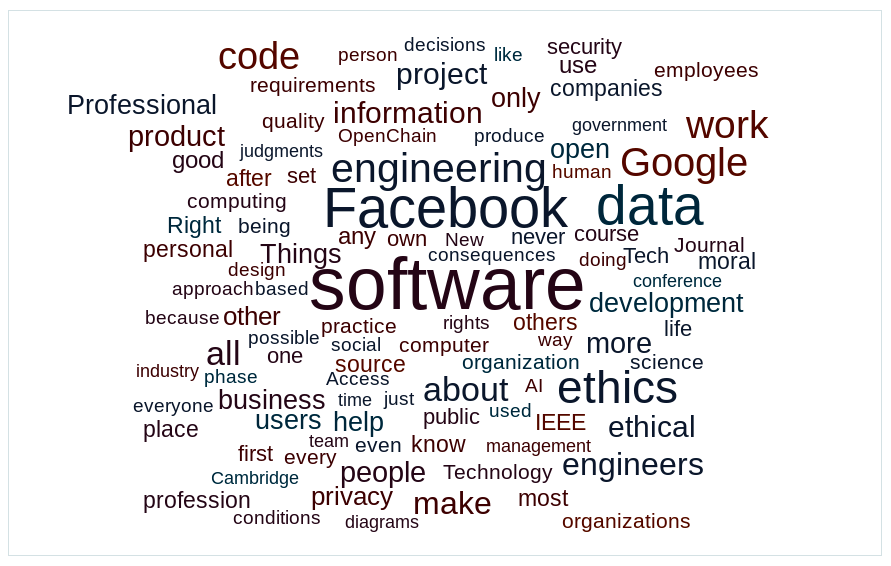
As you can see Facebook shines out there more than anything after software. This list is of bad things that happened at Facebook in one year8. That many things happened on Facebook. Should I work for Facebook is a divergent question and it’s one that I would encourage you to think about.

Let’s look at another case in detail. I love VW. This is my VW. I love it. I’ve always loved VW. I did my motor mechanics apprenticeship on VWs. I like VWs. Suffice it to say I was super disappointed with VW recently. Most of you might know but I’ll give you the Reader’s Digest condensed version. VW had to meet US emission limits. They soon discovered they could not meet US emission limits so they did what every good software engineer does. They made a hack to solve the problem. The hack was to have test mode and road mode. When the car was in test mode it would pass the emissions limits test and when it was in road mode it would emit forty times more emissions than it was allowed to. In a completely unsurprising turn of events, people found out.
This case highlights the failures of a compliance mindset. If there are rules then you have to meet the requirements of the rules. If you can’t meet the requirements of the rules for something you wish to achieve then you do what every software developer does every day. You write a hack to get the things done, even if it is not exactly within the rules. This is fine for technical problems. This is not fine for ethical problems.
The prosecutor in the case said “he knew that what he was doing was wrong but he minimized his own moral responsibility for the fraud by reassuring himself that he was just an engineer doing his job and his job was to present practical solutions to problems regardless of their propriety”. Propriety takes us back to the Nazis again because after the Nuremberg trials of Nazis for war crimes after the second world war a set of principles were put forward to be used to judge what constitutes a war crime. Principle four states “The fact that a person acted pursuant to order of his Government or of a superior does not relieve him from responsibility under international law, provided a moral choice was in fact possible to him”9. A moral choice was in fact possible for him. He could have refused. Some people would say he had no choice as he would lose his job. That is a choice. You always have a choice. There is however no guarantee that you will like the choices available to you. But you always have one. This kind of problem cannot be the case that it is a few rogue engineers. It went all the way up the ladder. The engineer was sentenced to three years in prison and ordered to pay $200,000. VW is set to pay $4.3 billion in criminal and civil penalties. And, for once, an executive was actually jailed. The judge commented “You viewed this cover up as an opportunity to climb the corporate ladder. Your goal was to impress senior management.” I reckon they all know about him now.
This kind of situation is especially relevant to us as Australians because we now have the wonderful Assistance and Access Act10 by means of which our glorious leaders can come to us and say backdoor that software and don’t tell anyone. If this happens to you, you have a moral choice to make. You as software developers are some of the best paid people in the world because there is such a high demand for your services. This means you are in a fabulous position to actually take a moral stand and say, “no I am not going to write that backdoor. I am not going to keep my company in Australia where I am subject to those provisions”. If people like you who are really well off and can easily get another job, how many software developer positions are there vacant? There’s a billion of them, if you guys can’t act morally how can anyone else? There are things that can be done, for example some software developers have formed a union.
What can you do? As I mentioned previously, we are in this axial age, and in the coming time I put it to you that major changes in our society will not be happening because governments do things, because look at them. Rather they will be brought about by the actions of individual people. Maybe a whole lot of individual people who get together and do something of their own volition, but individual people. Epictetus was a Greek philosopher of the first century BCE and he was a very smart guy. He was a slave and he was a philosopher. He basically said change the stuff you can change. Sweat over the things that you know you can change and don’t worry about the other things. Can I change that Facebook has twenty scandals in a year? If you work at Facebook you can. Can I change the fact that an orange headed maniac is in the White House? No you can’t change that unless you’re an American. Then you can try and change that, but here we can’t change that. Work on the things you can change.
“We have no power over external things, and the good that ought to be the object of our earnest pursuit, is to be found only within ourselves” – Epictetus, the Enchiridion
You need to know what your own morality is. Nobody’s morality is going to be the same and I’m not here to tell you what your morality should be. But know what it is because then you will recognize things that do not fit into your morality. When you are given an interesting challenge to work out about how to track Wi-Fi you might say to yourself, why is a Wi-Fi access point moving oh it’s a person and maybe you want to kill the person. No, I am not going to help you with that. Think about what you’re doing beyond the technical. Know what your morality is and be aware of the problem.
But also be aware that the road to hell is paved with good intentions. Some guys at Lerner tried to do this thing where they said we’re not going to let people in ICE (the American Immigration service) use our software11. Once they did this they discovered two things, one it’s unenforceable and two it’s no longer free and open source software once you do that.
Codes of conduct are super popular right now. They are not the answer, but they are a good place to start. Here are a whole bunch of different codes of conduct that people have worked up. Creating codes of conduct is useful because it starts a conversation where you think about these things, but people do not do things because there is a code of conduct that says they should. You can’t just give your new hire a code of conduct and say do this thing and expect they will do it. You need to make sure that the people you hire share your moral code, whatever that code is.
The things you need in order to be an ethical software developer. Follow these five easy tips to perfect ethical software development.
Integrity. Just say no. Like this guy12, who quite working for My Health Record because they were doing dodgy things. Or these students13 who pledged not to interview at Google because of their connections to the Pentagon. Or Jan Koum, one of the founders of WhatsApp, who, after selling it to Facebook, left the company over concerns about their data policies14.
Courage – neutrality helps the oppressor. If you do nothing bad things happen. Be like these Scottish workers in the Kilbride Rolls-Royce plant who refused to repair Hawker Hunter engines damaged during the brutal 1973 US-backed coup in Chile that led to the death of democratically elected president Salvador Allende15.
Develop your courage, develop your integrity, recognize your power. You guys have the power. People need you. People are desperate for really good software developers. Take that power and use it in an ethical way whatever your moral code.
Questions:
Audience member 1: Thank you for the talk really appreciate that. Some food for thought. One of the things that I hope you could comment on but we go back to capitalism now capitalism as we know still requires a governing authority to actually drive something so there still has to be property ownership etc. but it struck me or has struck me for a while that the open source Community is actually the epitome of a capitalist free market you know if stuff is useful it gets used if it doesn’t get useful it doesn’t get used so have you got any comments on that?
Me: What exactly is your question? Do I think that free and open software is a capitalist system is that your question?
Audience member 1: Or do you disagree?
Me: No. Because the ethos of free and open software isn’t actually about capital. It’s all about the ideals.
Audience member 1: Forget the money side of capitalism
Me: You can’t forget the money side of capitalism because it’s capital-ism
MC: I want to just put out that putting a statement out there and then asking do you agree is probably not a question.
Me: The lady here has a question.
Audience member 2: Hi I first of all wanted to say I was sorry for singing out before I just got a bit enthusiastic.
Me: That’s ok. It’s fine.
Audience member 2: The terms ethics and morals, you use them and you sort of go between the two. I know how I would differentiate between them but can you specify what you are thinking when you use those two?
Me: Ethics is using your rational faculties in order to arrive at moral ideals and morality is the content of the moral ideals that you arrive at. Does that answer your question?
Audience member 2: Thank you, about the same but I just wanted to check.
Audience member 3: That was a really great talk and I’m really glad that we’re seeing more discussion of you know not just the sort of the principle of being open but what it’s doing is it making the world a better place? Are we asking the right philosophical questions or are we kind of getting bogged down in like you know iterations of the trolley problem and how many kittens would you have to poke in order to get a pizza?? How can we ask the right, those larger moral questions
Me: Basically any question you ask is the right question because if you ask a question you’re thinking about the problem and to be frank most of software development land is not thinking about the problem. They’re thinking about how to look like they’re thinking about the problem. They’re writing codes of conduct like mad. So any question you ask is a good question. In divergent questions there are no absolutes. In the human condition objectivity is impossible because objectivity requires complete knowledge and we are not omniscient. Only gods get to be objective. Okay so for us any question, any exploration is a good exploration. It’s about your motivation and what you do with the answers that you get. Does that answer your question? Thank you.
Audience member 4: Hi thank you for the talk. I know that you’re speaking generally about ethics and software development and the way those things intersect. I wonder what your personal opinion was about how passive resistance would work in terms of your ethical response to something. Do you think that passive resistance is a useful thing to do? For example if you’re working for Facebook, they pay extremely well, if you are not in a position to quit that job because of extenuating circumstances where that’s not really a privilege that you have in a realistic world do you think that passive resistance such as the way that they used to say you know if you want to resist the Nazis take a bag of moths to a cinema and release it so that they cover the screen so you can’t see what’s on the screen, Do you think that that would work personally for you?
Me: Two things; one it is my personal opinion that no one who works for Facebook is in a position where they can’t quit because of the high rate of vacancies for software developers. I recognize for Americans it’s difficult to quit because when they quit and start a new job often their health care is in abeyance for some time so that is difficult. But it’s always possible. It’s about this thing, courage. The other part of your question; yes passive resistance works, but do you want to be fighting an important battle all the time or do you want to go somewhere else where you don’t have to fight that battle and you can contribute in a more positive, active way to a project which is really doing good. So you’re not just in a holding pattern. Rather than than trying to stop evil try to advance good. Because you’ll be more happy. And I think it will be more effective.
MC: Unfortunately we have run out of time. Please can we have another round of applause for Dr. Morgan Leigh.
Me: Thank you
- https://ooze.net/wp-content/uploads/2026/03/Virtually-Real-M-Leigh.pdf ↩︎
- https://www.eff.org/cyberspace-independence ↩︎
- https://www.eff.org/cyberspace-independence ↩︎
- https://www.eff.org/cyberspace-independence ↩︎
- https://www.eff.org/cyberspace-independence ↩︎
- Arthur C. Clarke Voices From the Sky: Previews of the Coming Space Age (1967), p156. ↩︎
- https://www.ecosophia.net/blogs-and-essays/the-well-of-galabes/conjuring-in-the-house-of-mirrors/ John Michael Greer ↩︎
- https://www.wired.com/story/facebook-scandals-2018/amp ↩︎
- https://en.wikipedia.org/wiki/Nuremberg_principles ↩︎
- https://www.homeaffairs.gov.au/about-us/our-portfolios/national-security/lawful-access-telecommunications/data-encryption ↩︎
- https://www.jwz.org/blog/2018/08/major-open-source-project-revokes-access-to-companies-that-work-with-ice/ ↩︎
- https://amp.smh.com.au/technology/my-health-record-s-privacy-chief-quits-amid-claims-agency-not-listening-20181107-p50elu.html ↩︎
- https://gizmodo.com/students-pledge-to-refuse-job-interviews-at-google-in-p-1826614260 ↩︎
- https://www.nytimes.com/2018/04/30/technology/whatsapp-facebook-jan-koum.html ↩︎
- https://www.thecanary.co/uk/2018/10/31/remember-when-scottish-workers-stood-up-to-a-brutal-dictatorship-one-filmmaker-wants-to-make-sure-we-do/ ↩︎